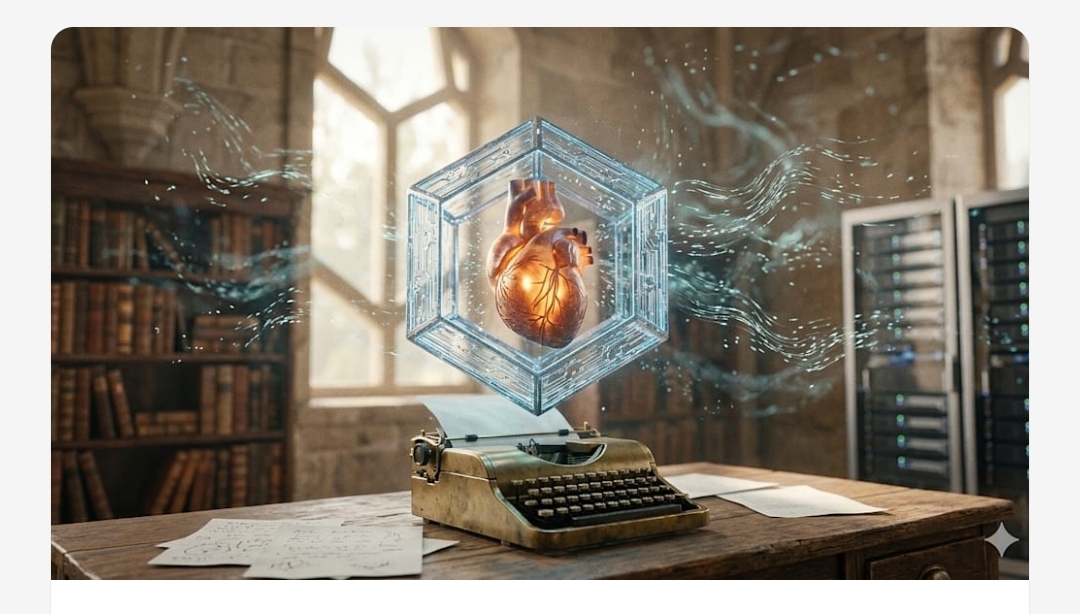
The Oxygen of our Epoch where AI Sustains but Authenticity Animates
In an age where Artificial Intelligence writes in seconds, sings in millions, and dazzles in devices, the question is no longer what AI can do—but what remains uniquely human. This article is my reflection on balance: how AI and humanity can coexist, not in opposition, but in symphony.
If you recollect my last article, which was around authenticity and emotions in the age of AI, I would be immensely stirred by the thought of how things are aligning.
People really want to balance the two. Nothing overpowers anyone, nor underlines. That’s the determination we saw.
We saw how AI is helping doctors with small treatments, how AI is helping technological advancements—especially in ongoing fragile situations around us. Yes, nothing is connivance in the process, but the opposite is also true: authenticity still matters.
That’s where we just saw news a day back—Sony is actually removing songs created by AI from their playlist. Not in tens, or hundreds, or thousands, but in numbers reaching millions.
Will it not affect the company? It definitely would. But that’s what is important: it valued the effort of the artist.Hats off to the efforts.
The genuine emotion which came from his own pen, when he might have got this thought on a busy bustling street, on a green garden podium, amidst listening to his favorite songs. That is raw—that is the authenticity to maintain.
AI is the oxygen, but not the body, brain, and heart.
All correlate: one collapses, the other perhaps would be afraid to survive—at least in AI’s age. But what does survive, how it can help you balance, or suggest an alignment toward your thought—no hallucination, no copy‑paste, no AI phobia, no paranoid human juggling in the jungle of deeply dense thoughts.
Now that we saw my erred poetic site allows me to dismay a bit vocally on the AI part—to shake hands with me but not overpower—I perhaps would indeed agree to a great extent on the quintessential transitions happening in the snap of your fingers, under your palms.
Of course, as someone who has breathed tech career‑wise, doesn’t that become capillary to the very process of being in the shell of dilemma, or the cocoon of AI, which is now a beautiful butterfly? But let the larvae be the authenticity of the butterfly, which never fades.
There come some under‑our‑eyes scans and checks in the market, where we saw—apart from the Sony news—the other example where programmers can now code in 30 minutes compared to the minimum 3–5 days it once required. Is that not beautiful? Yet was it more beautiful that the programmer still has to be the master—to control this code, to ensure it does not go haywire, and to preserve the momentum? That mastery, that vigilance, is authenticity: the human hand guiding the machine.
We also saw how new consumer tech launches are flaunting and wooing the audience with the latest devices—Vivo T5x 5G, Samsung’s newest releases. How AR football challenges tied to the FIFA World Cup 2026 are dazzling fans—evidence of AI’s ubiquity in entertainment. Yet the authenticity here lies in the joy of the audience, the lived experience of cheering, playing, and connecting. The devices may be powered by AI, but the emotions they evoke are human.
Even the frontier AI models from OpenAI, Anthropic, and Nvidia are accelerating multimodal capabilities and reshaping industries at breakneck speed. But authenticity remains in how we choose to apply them—whether to solve problems with dignity, to create responsibly, or to preserve the human voice amidst the noise.
These developments show how AI is oxygen—pervasive, sustaining, indispensable—but authenticity remains the beating heart.
Artificial Intelligence may well be the oxygen of our epoch—ubiquitous, indispensable, and invisible in its diffusion. Yet oxygen alone does not constitute life; it requires the corporeal body, the sentient brain, and the beating heart. Authenticity is that heart. Without it, creation becomes a cadaverous imitation, a simulacrum devoid of soul. Thus, the true challenge of our age is not to vanquish AI, nor to venerate it, but to orchestrate a symphony where machine efficiency harmonises with human authenticity.
Rachana Bahel