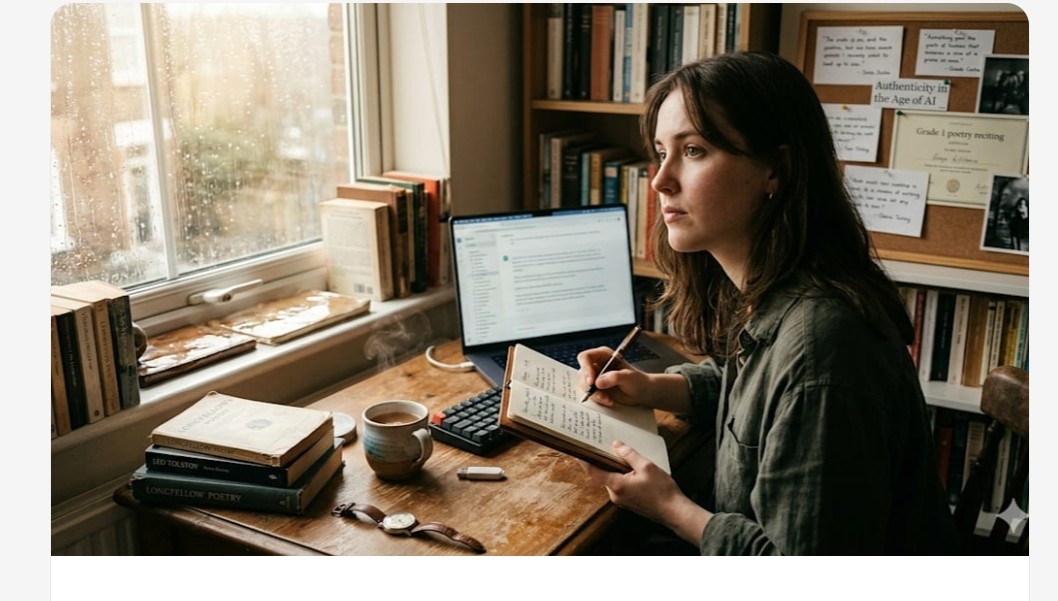
The Pen, the Program, and the Paradox of Authenticity
I recently came across a few effervescent articles and journals from Sage (AI And Authenticity) and Oxford(AI & Humanity) that explore the depth of studies on AI and human creativity. One Sage study discusses how trust in AI is still fragile, with people struggling to distinguish real from artificial content. Oxford’s symposium on AI and the Self raised similar concerns—how AI challenges identity, dignity, and the very idea of what it means to be human. Reading these made me realise something I’ve been feeling for a long time: authenticity is not just the subject of the hour—it is the call of the hour.
Especially now, when AI can generate scripts in seconds, the thin line that once separated genuine human thought from machine‑generated writing is becoming increasingly blurred.
I say this as someone who has always been deeply and immensely influenced by great authors—William Shakespeare, Leo Tolstoy, Rudyard Kipling, Franz Kafka, Han Kang, Toshikazu Kawaguchi, Mitch Albom, Harivansh Rai Bachchan, to name a few. Their writing was not polished by technology; it was polished by emotion, experience, and raw human truth.
My own journey began in school when I won my first award in Grade 1 for reciting “The Arrow and the Song” by Henry Wadsworth Longfellow. I was in awe of how he captured an entire situation in just three stanzas. That poem inspired me to start writing, and my first poem—though I barely remember it now—was probably “Don’t Quit.” (I still have that poem tucked away somewhere, but I’ll share it another day—I don’t want to break the momentum of this piece.)
What I do remember is the feeling: the excitement of creating something that came from me.
That is the beauty I fear we are losing today—the beauty of something written with emotion, rawness, and most importantly, authenticity.
Authenticity Under Pressure
We all understand that the human touch will never truly disappear. But the way people have become so reliant on artificial intelligence has created a new kind of fear—the fear that authenticity is fading.
Ever since AI became mainstream, every time I write a poem, someone inevitably asks: “Did you write it with AI?” Or more bluntly: “Anybody can write through AI now.”
It’s not their fault. This is the era we are living in. Subconsciously, we are all overwhelmed by the expanding horizon of what AI can do. And somewhere in that expansion, the value of human creativity is being questioned.
A recent Sage-backed study on how young people judge AI-generated media shows how difficult it has become to distinguish real from artificial. People now rely on tiny cues—sound, image quality, narrative consistency, even intuition—to verify authenticity. This alone shows how fragile the idea of “real” has become.
The Technology Behind the Tension
AI today is not just a writing tool—it is a creative engine powered by:
Large Language Models (LLMs) that can mimic tone, rhythm, and style
Generative image models that create photorealistic visuals
Deepfake technology that can replicate faces and voices
Recommendation algorithms that shape what we see and believe
Synthetic influencers who look and behave like real people
This technological ecosystem has created a world where:
A poem can be generated in 5 seconds
A face can be invented from nothing
A voice can be cloned from a 3‑second clip
A “writer” online may not be human at all
And in this world, authenticity becomes both more valuable and more vulnerable.
The AI Hallucination Problem
Another important aspect is that AI itself is hallucinated at times. It can produce confident answers that are completely wrong. It can mimic emotion but cannot feel it. It can imitate style but cannot live it.
And that is exactly where the human touch becomes irreplaceable.
AI phobia is real, but AI hallucination is the reminder that machines cannot replace imagination. They can only imitate it. They can only guess. They can only assemble patterns. But they cannot dream.
Why Authenticity Matters Even More Now
We are living in a time where misinformation, deepfakes, AI‑generated influencers, and machine‑written content are everywhere. People are beginning to doubt what they see, hear, and read. In such a world, authenticity becomes a form of truth‑telling.
Oxford’s symposium on AI and the Self raised the same concern: AI can distort identity, misrepresent people, and even erode dignity when used carelessly. Philosophers argued that authenticity is becoming a higher‑order value—something we must actively protect.
Human writing carries memory, pain, joy, hesitation, lived experience—things no algorithm can replicate. AI may write faster and cleaner, but it cannot write with a childhood memory in its chest. It cannot write with heartbreak in its bones. It cannot write with the weight of a life lived.
The Irreplaceable Human Touch
So yes, authenticity has become a challenge. But it has also become a responsibility. A responsibility to keep writing, keep creating, keep expressing—because the world still needs the human voice.
AI may write beautifully. It may write convincingly. But it cannot write you.
And that is the whole point.
And thus I sign off, allowing my literary zeal and spark to take their final bow. Yet, in the spirit of full disclosure, dear reader, while the prose is entirely mine, the accompanying picture has been dutifully crafted by my loyal digital butler, AI. 😌✨
Rachana Bahel