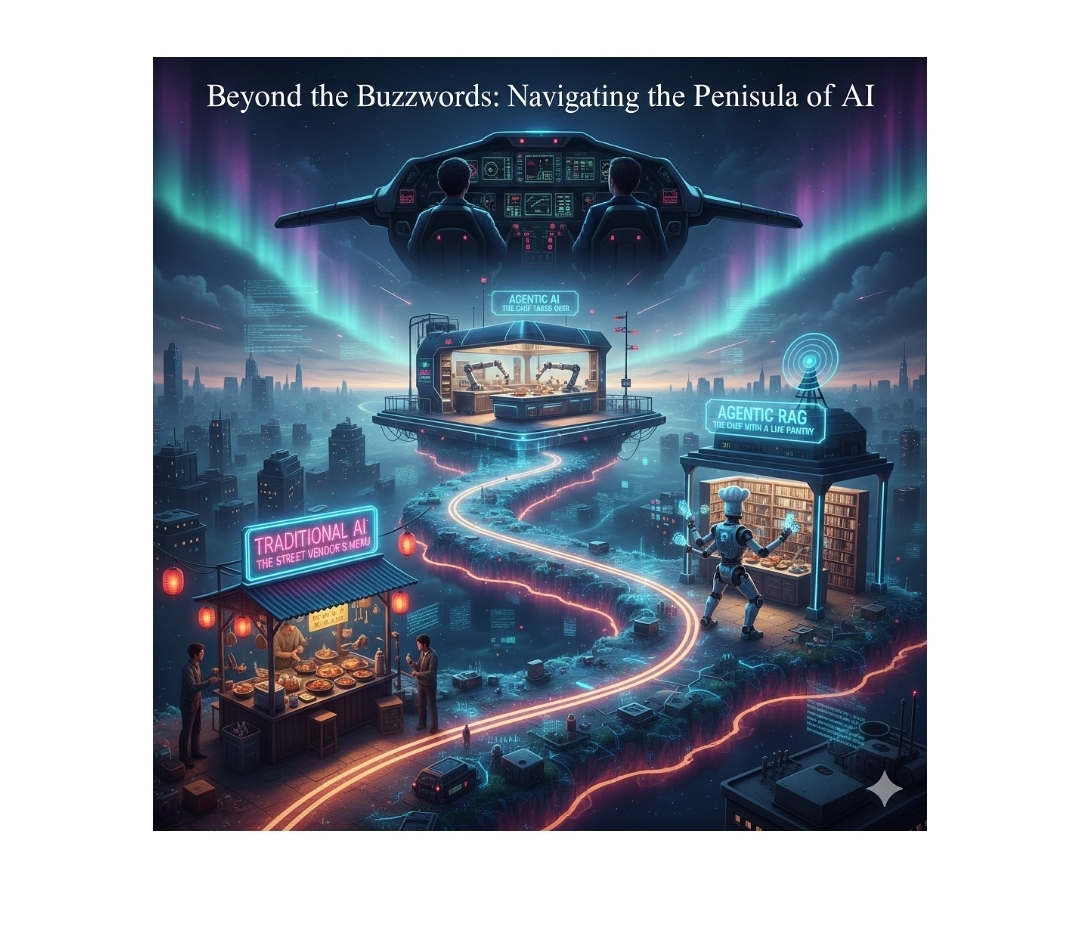
Beyond the Buzzwords: Navigating the Peninsula of AI
From Passive Search to Agentic Action
The tech world is currently obsessed with "Agentic AI." But to lead effectively, we need to cut through the noise. We are moving from a world where AI is a passive search bar to one where it actually has a job description.
While many are riding the AI wave, few stop to understand the depth and distinctions between the three pillars of modern intelligence: Traditional AI, Agentic AI, and Agentic RAG. Whether you are a "Passenger" (user) or a "Pilot" (leader), understanding these differences is the delta between a safe landing and a total system failure.
1. The Three Paradigms: A Layman’s Deep Dive
Traditional AI: The Street Vendor’s Menu
Traditional AI is simple logic at scale. If you ask it to write a poem about a cat, it generates it based on patterns it already knows. It is predictable, repeatable, and relatively "cheap" in terms of reasoning.
The Analogy: It’s like a street vendor. You ask for fried rice; you get fried rice. But ask for a complex, off-menu substitution like gluten-free sushi, and the vendor shrugs. There is no improvisation and no accountability.
Agentic AI: The Chef Who Takes Over the Kitchen
Agentic AI doesn’t just answer; it acts. It is like the great Oxford Dictionary coming to life to help you plan a trip. It explores multiple paths, analyzes patterns, and "window shops" the internet on your behalf to find the best possible outcome.
The Analogy: This is a chef who doesn’t wait for your order. He knows you’re hungry and starts preparing a five-course meal. It is impressive and autonomous, but risky. Without guardrails, he might serve you sushi when you actually wanted soup.
Agentic RAG: The Chef with a Live Pantry
Retrieval-Augmented Generation (RAG) adds a layer of real-time truth. Agentic RAG combines the autonomy of an agent with a verified retrieval pipeline. It doesn’t just rely on its "memory" (training data); it checks the "pantry" (external databases) in real-time.
The Analogy: This is a chef who checks the pantry for freshness, cross-checks recipes against your dietary needs, and then executes. It is autonomy with radar—no "secret sauce" excuses, just traceable, fact-based execution.
2. The Pilot and The Passenger: A Governance Framework
In this new world, Users are Passengers and Leaders are Pilots. ### The Passenger’s Responsibility As a passenger, you want to land safely. Every time you "prompt" an AI, you are boarding a flight. Even though the Pilot (the system/leader) operates the craft, it is your responsibility to understand the risks:
Traditional AI gives you lucky outputs.
Agentic AI gives you bold outputs.
Agentic RAG gives you resilient outputs.
The Pilot’s Commandment (Leadership)
Choosing between these three models is not optional; it is the cockpit of responsible innovation. When a system fails, leaders shouldn't ask who pressed the button—they should ask why no one was steering the plane.
Don't rely on Autopilot: Traditional AI is like a commercial flight on autopilot. It works until the weather changes. If the "runway" of your business context shifts, Traditional AI cannot improvise.
Govern the Freedom: Agentic AI is the co-pilot who can troubleshoot errors and write code without waiting for you. But a pilot with too much freedom can improvise into chaos. You must provide the checklists and oversight.
Fly with Radar: Agentic RAG is the ultimate upgrade. It provides live navigation and weather updates. It reduces "hallucinations" by grounding decisions in real-time facts.
The Leadership Verdict
Treat these AI paradigms as your cockpit.
Traditional AI is for repetition—but don't confuse predictability with adaptability.
Agentic AI is for autonomy—but don't confuse freedom with a lack of governance.
Agentic RAG is for resilience—but don't confuse retrieval with wisdom. It still needs a human at the helm.
In the peninsula of AI, the delta is the common point where technology meets human accountability.
If you don't understand these distinctions, you aren’t leading—you’re gambling.
Rachana Bahel.