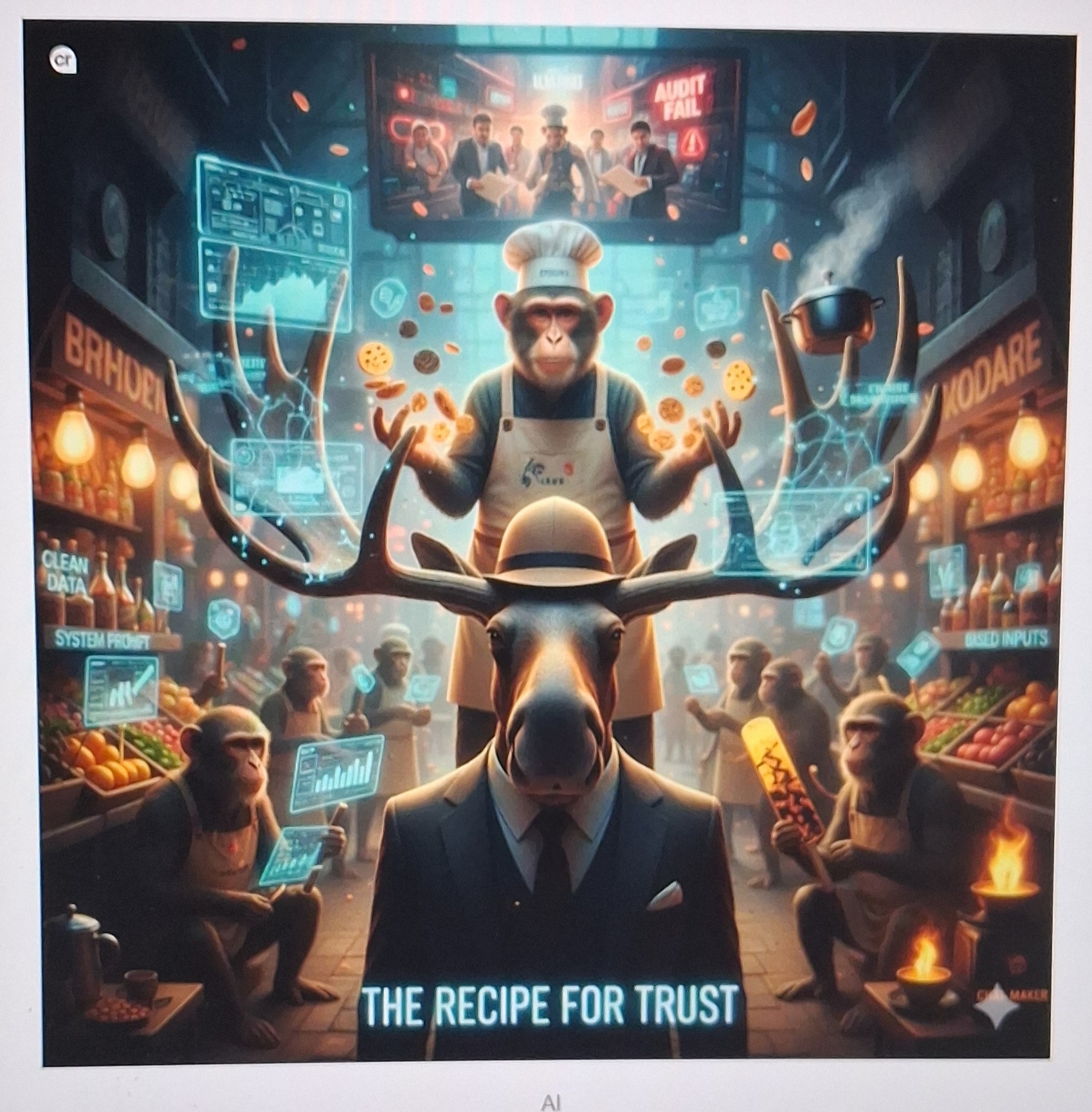
The Monkey and the Moose of AI
I. The Theory: The Bazaar Monkey
I was recently wandering around a national park, watching monkeys in the trees. Most were minding their own business, but the moment they saw food, they’d try to snatch it. However, there were a few "sophisticated" ones—they would behave, act poised, and imitate whatever we asked of them just to get the treat.
AI is that second type of monkey. It behaves well and imitates perfectly when prompted, but we must not forget: all it does is copy.
Imagine this monkey enters a digital bazaar filled with the delicious smells of "yummy cuisines" (data) and is asked to imitate the result. Is it fun? Not really. The monkey’s agenda isn’t to be sophisticated; it just wants the treat.
That is where we are with AI. It is a digital bazaar full of monkeys that seem brilliant because they’ve swallowed the internet whole. They mirror our wisdom back at us, but let’s be honest—they don’t “think” any more than your toaster does. It’s autocomplete on steroids, still just chasing the treat.
In 2021, Emily Bender and Timnit Gebru coined the phrase “Stochastic Parrots.” Their point was sharp: these systems don’t grasp meaning; they stitch words together statistically. My bazaar monkey is the same creature. It isn’t thinking; it’s predicting. That is the Stochastic Reality.
II. The Data: Kitchen Inspections
Feeding an LLM stale or outdated data is like ordering oily fast food for a team strategy session. You love the taste for five minutes, but that extra cholesterol plays havoc with your system, making you lethargic and draining your brain.
In leadership, you wouldn't send your best player to the crease with a cracked bat. The crowd might cheer the name, but the innings will collapse before it begins. Similarly, a tech leader must inspect the "food" their team consumes. Clean data is your base source; bias is the "cracks" in the bat or the "unhealthy oil" in the meal.
Governance is the umpire calling a "No Ball" or the doctor spotting the symptoms of a bad diet. You need to know which “farm” your data came from before it hits the pot.
III. The Seasoning: Prompts and Versioning
If data is the ingredients, prompts are the seasoning. Seasoning can enhance the taste or ruin the palate if the quantity is wrong.
A rookie thinks the user prompt is the whole meal, but governance experts know the System Prompt—those hidden, top-level instructions—is the base broth. If a model starts sounding over-enthusiastic, that’s a recipe for hallucinations.
Leaders must implement Prompt Versioning. Treat prompts like cricket scorecards—every change logged, every flavor tracked. If the taste shifts after an update, you should be able to roll back faster than a batsman reviewing a bad LBW call.
IV. The Governance: The Heat and the Umpire
Once the dish is seasoned, you must monitor the heat so it doesn't burn. This is where Red Teaming comes in.
Think of Red Teaming as verbal sledging in cricket. You deliberately provoke the model to see if it cracks or loses its cool. If the parrot blurts out nonsense under pressure, your guardrails are too thin. We also need Automated Evaluation—a restricted AI "tasting" the soup for toxicity or bias before it reaches the customer's plate.
Finally, we face the ultimate nightmare: The Audit. An AI audit without dashboards is like a Bollywood movie without a script supervisor. The hero forgets his lines, the villain shows up in the wrong scene, and the audience walks out confused. Real leadership means building Observability Dashboards. If the parrot starts squawking nonsense at 2 AM, your dashboard should smell the smoke before your customers do.
The Bottom Line
AI won’t replace leaders, but it will amplify the ones who act like chefs. Don’t be dazzled by the monkeys in the bazaar. Be the chef, the umpire, the director, and the chai-maker—the one who ensures the final cup warms the soul instead of burning the tongue.
Governance isn’t paperwork. It’s the recipe for trust.
Rachana Bahel